
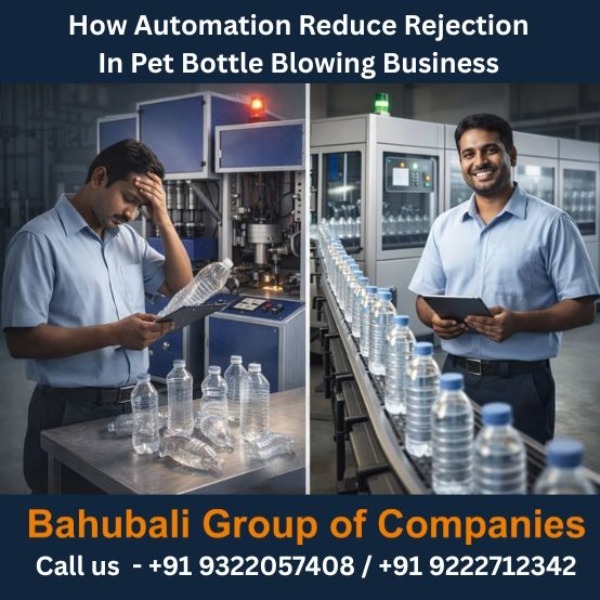
Role of Automation in Reducing Bottle Rejection Rates A Practical Insight for Jaipur Industrial Zones in Rajasthan Bottle rejection is one of the biggest hidden expenses in PET bottle manufacturing. Many manufacturers in and around Jaipur face losses not because orders are less, but because bottles get rejected due to uneven shape, weak walls, or deformation. These problems are mostly seen in plants that depend on manual or semi-automatic machines. As Jaipur grows as a major packaging hub, automation in PET bottle blowing machines is becoming a key factor in reducing rejection and improving daily production efficiency. Why bottle rejection is common in Rajasthan In industrial areas like Sitapura, factories often run long shifts to meet packaged drinking water demand. In VKI (Vishwakarma Industrial Area), high output pressure combined with manual handling causes variation in bottle quality. Units in Malviya Nagar Industrial Area frequently change moulds and bottle sizes, which increases rejection when heating is not consistent. Plants in Mansarovar Industrial Area face another challenge—very high summer temperatures that affect PET processing stability. Manufacturers in Jodhpur, Neemrana, Bhiwadi, and Alwar face similar issues when production increases without upgrading automation. How automation directly reduces bottle rejection Uniform preform heating Many manufacturers ask why bottles stretch unevenly. The reason is unstable heating. Automatic PET bottle blowing machines keep the same heating profile for every preform, reducing rejection seen in semi-automatic setups used in Jhotwara. Accurate air pressure control Another common doubt is why bottles fail during transport. Automation controls both low and high-pressure air precisely, which is important for suppliers from Bagru Industrial Cluster, where bottles must pass stacking and transport tests. Less dependency on operators Rejection often increases during night shifts. Automation reduces operator-related variation, which helps units in Sikar and Sri Ganganagar maintain consistent quality even during long working hours. Quality maintained at higher speeds Many manufacturers worry that higher speed means more rejection. With automation, even plants in Kota and Ajmer maintain bottle quality while increasing output. Proper cooling before bottle removal Automatic machines ensure correct cooling time before ejection. This prevents deformation, a common issue seen in oil and FMCG packaging units in Bhilwara. Manufacturers upgrading in Neemrana and Bhiwadi often notice quick improvement in rejection control after shifting to automatic systems. Why automation matters more in Rajasthan’s climate Rajasthan’s high temperatures directly affect PET processing. Automated machines adjust heating and blowing parameters automatically, helping factories in Jaipur, Jodhpur, Alwar, Kota, Ajmer, and Sri Ganganagar maintain stable quality throughout the year. Building a low-rejection PET bottle plant Manufacturers often ask what really reduces rejection. The answer lies in automatic preform feeding, PLC-controlled blowing cycles, stable air supply, preventive maintenance, and machines designed for Indian conditions. This is where Bahubali Blowing Machine adds strong value. Their automatic PET bottle blowing machines are designed for real factory environments, offering stable performance, simple operation, and reliable results even with frequent mould changes. Across Jaipur’s industrial zones—Sitapura, VKI, Malviya Nagar, Mansarovar, Jhotwara, and Bagru—and throughout Rajasthan’s major manufacturing centers like Neemrana, Bhiwadi, Alwar, Kota, Ajmer, Bhilwara, Jodhpur, Sikar, and Sri Ganganagar, automation has become the most effective way to reduce bottle rejection. By reducing human dependency and controlling every stage of the PET blowing process, automation helps manufacturers achieve consistent quality, lower wastage, and predictable profitability.


This is your website preview.
Currently it only shows your basic business info. Start adding relevant business details such as description, images and products or services to gain your customers attention by using Boost 360 android app / iOS App / web portal.
How To Reduce Rejection in Pet Bottle Blowing Pocess | Bahubali Blowing Machine in Jaipur Rajasthan
2025-12-27T06:30:01
Role of Automation in Reducing Bottle Rejection Rates A Practical Insight for Jaipur Industrial Zones in Rajasthan Bottle rejection is one of the biggest hidden expenses in PET bottle manufacturing. Many manufacturers in and around Jaipur face losses not because orders are less, but because bottles get rejected due to uneven shape, weak walls, or deformation. These problems are mostly seen in plants that depend on manual or semi-automatic machines. As Jaipur grows as a major packaging hub, automation in PET bottle blowing machines is becoming a key factor in reducing rejection and improving daily production efficiency. Why bottle rejection is common in Rajasthan In industrial areas like Sitapura, factories often run long shifts to meet packaged drinking water demand. In VKI (Vishwakarma Industrial Area), high output pressure combined with manual handling causes variation in bottle quality. Units in Malviya Nagar Industrial Area frequently change moulds and bottle sizes, which increases rejection when heating is not consistent. Plants in Mansarovar Industrial Area face another challenge—very high summer temperatures that affect PET processing stability. Manufacturers in Jodhpur, Neemrana, Bhiwadi, and Alwar face similar issues when production increases without upgrading automation. How automation directly reduces bottle rejection Uniform preform heating Many manufacturers ask why bottles stretch unevenly. The reason is unstable heating. Automatic PET bottle blowing machines keep the same heating profile for every preform, reducing rejection seen in semi-automatic setups used in Jhotwara. Accurate air pressure control Another common doubt is why bottles fail during transport. Automation controls both low and high-pressure air precisely, which is important for suppliers from Bagru Industrial Cluster, where bottles must pass stacking and transport tests. Less dependency on operators Rejection often increases during night shifts. Automation reduces operator-related variation, which helps units in Sikar and Sri Ganganagar maintain consistent quality even during long working hours. Quality maintained at higher speeds Many manufacturers worry that higher speed means more rejection. With automation, even plants in Kota and Ajmer maintain bottle quality while increasing output. Proper cooling before bottle removal Automatic machines ensure correct cooling time before ejection. This prevents deformation, a common issue seen in oil and FMCG packaging units in Bhilwara. Manufacturers upgrading in Neemrana and Bhiwadi often notice quick improvement in rejection control after shifting to automatic systems. Why automation matters more in Rajasthan’s climate Rajasthan’s high temperatures directly affect PET processing. Automated machines adjust heating and blowing parameters automatically, helping factories in Jaipur, Jodhpur, Alwar, Kota, Ajmer, and Sri Ganganagar maintain stable quality throughout the year. Building a low-rejection PET bottle plant Manufacturers often ask what really reduces rejection. The answer lies in automatic preform feeding, PLC-controlled blowing cycles, stable air supply, preventive maintenance, and machines designed for Indian conditions. This is where Bahubali Blowing Machine adds strong value. Their automatic PET bottle blowing machines are designed for real factory environments, offering stable performance, simple operation, and reliable results even with frequent mould changes. Across Jaipur’s industrial zones—Sitapura, VKI, Malviya Nagar, Mansarovar, Jhotwara, and Bagru—and throughout Rajasthan’s major manufacturing centers like Neemrana, Bhiwadi, Alwar, Kota, Ajmer, Bhilwara, Jodhpur, Sikar, and Sri Ganganagar, automation has become the most effective way to reduce bottle rejection. By reducing human dependency and controlling every stage of the PET blowing process, automation helps manufacturers achieve consistent quality, lower wastage, and predictable profitability.
2025-12-27T06:30:01


Keywords
- Reliable PET bottle manufacturing Rajasthan
- High-temperature PET processing solutions
- PLC-controlled blowing cycle advantages
- Plastic packaging industry Jaipur
- Bottle quality control automation Rajasthan
- Automatic PET bottle blowing machines
- Uniform preform heating techniques
- Rajasthan industrial PET manufacturing
- Automation in PET bottle blowing
- PET bottle rejection reduction strategies
Submit Your Enquiry