
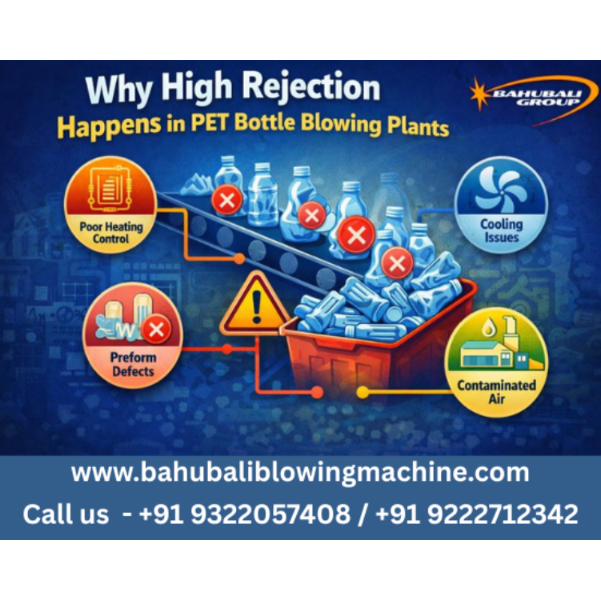
Why High Rejection Happens in PET Bottle Blowing Plants High rejection is one of the biggest problems faced by PET bottle blowing plants. Many manufacturers try to increase machine speed to boost output, but when rejection goes up, usable production goes down. This directly affects profit. In most cases, rejection does not happen because of PET material alone. It usually comes from process imbalance, incorrect settings, or shortcuts taken during daily operation. Understanding the real reasons behind rejection helps control it effectively. What does rejection actually mean in bottle manufacturing? In PET bottle production, rejection means bottles that are deformed, oval, thin, weak at the base, leaking near the neck, or failing stacking and drop tests. Every rejected bottle wastes electricity, compressed air, machine time, and raw material. Is uneven preform heating the main reason? Yes. Inconsistent preform heating is the most common cause of rejection. When some areas are too hot and others too cold, the bottle stretches unevenly. Using stable heating profiles, keeping heating lamps clean, and avoiding frequent manual changes help reduce this problem. A well-designed automatic PET bottle blowing machine maintains repeatable heating and lowers rejection. Does increasing air pressure reduce defects? Many operators believe higher pressure improves bottle strength, but this is not true. Excess pressure over-stretches PET and causes thin walls and base deformation. Correct low-pressure and high-pressure air timing in a PET bottle blowing machine gives better quality than blindly increasing pressure. Can poor cooling cause rejection after ejection? Yes. Reducing cooling and holding time to increase output often causes bottles to lose shape after coming out of the mold. This leads to stacking problems and transport damage. Proper cooling is essential, especially for larger bottles and jars. Is high-speed operation always a good idea? Only when the process is stable. Running machines at high speed without balancing heating, blowing, and cooling creates internal stress. High-speed Plastic Bottle Making Machine setups perform well only after proper tuning. How much does mold condition affect rejection? Worn molds, blocked vents, or poor cooling channels cause surface defects and incomplete bottle formation. Regular mold inspection and maintenance are critical to control rejection. Does operator skill make a big difference? Yes. Manual adjustments and delayed reactions increase rejection, especially during long shifts. Automation reduces operator dependency and ensures consistent production. Machines from Bahubali Blowing Machine are designed for stable operation with user-friendly controls, helping plants maintain low rejection even during continuous production. Why is preventive maintenance important? Ignoring maintenance slowly increases rejection over time. Air leaks, dirty reflectors, poor cooling flow, and sensor drift all affect quality. Strict preventive maintenance keeps the PET bottle blowing machine running efficiently. How can rejection be reduced systematically? Lower rejection by stabilizing heating, optimizing air usage, ensuring proper cooling, maintaining molds, avoiding sudden speed changes, and training operators regularly. Manufacturers using machines from Bahubali Blowing Machine benefit from process-stable design, strong construction, and reliable performance under Indian factory conditions. High rejection in PET bottle blowing plants is not unavoidable—it is a process control issue. By understanding the causes and applying disciplined operating practices, manufacturers can greatly reduce waste. Lower rejection results in better energy efficiency, higher usable output, improved customer satisfaction, and long-term business stability. Consult with us today Bahubali Blowing Machine


This is your website preview.
Currently it only shows your basic business info. Start adding relevant business details such as description, images and products or services to gain your customers attention by using Boost 360 android app / iOS App / web portal.
How To Prevent Rejection In PET Bottle Blowing Plants | Automatic Pet Blowing Manufacturer in Jaipur
2026-01-04T05:30:08
Why High Rejection Happens in PET Bottle Blowing Plants High rejection is one of the biggest problems faced by PET bottle blowing plants. Many manufacturers try to increase machine speed to boost output, but when rejection goes up, usable production goes down. This directly affects profit. In most cases, rejection does not happen because of PET material alone. It usually comes from process imbalance, incorrect settings, or shortcuts taken during daily operation. Understanding the real reasons behind rejection helps control it effectively. What does rejection actually mean in bottle manufacturing? In PET bottle production, rejection means bottles that are deformed, oval, thin, weak at the base, leaking near the neck, or failing stacking and drop tests. Every rejected bottle wastes electricity, compressed air, machine time, and raw material. Is uneven preform heating the main reason? Yes. Inconsistent preform heating is the most common cause of rejection. When some areas are too hot and others too cold, the bottle stretches unevenly. Using stable heating profiles, keeping heating lamps clean, and avoiding frequent manual changes help reduce this problem. A well-designed automatic PET bottle blowing machine maintains repeatable heating and lowers rejection. Does increasing air pressure reduce defects? Many operators believe higher pressure improves bottle strength, but this is not true. Excess pressure over-stretches PET and causes thin walls and base deformation. Correct low-pressure and high-pressure air timing in a PET bottle blowing machine gives better quality than blindly increasing pressure. Can poor cooling cause rejection after ejection? Yes. Reducing cooling and holding time to increase output often causes bottles to lose shape after coming out of the mold. This leads to stacking problems and transport damage. Proper cooling is essential, especially for larger bottles and jars. Is high-speed operation always a good idea? Only when the process is stable. Running machines at high speed without balancing heating, blowing, and cooling creates internal stress. High-speed Plastic Bottle Making Machine setups perform well only after proper tuning. How much does mold condition affect rejection? Worn molds, blocked vents, or poor cooling channels cause surface defects and incomplete bottle formation. Regular mold inspection and maintenance are critical to control rejection. Does operator skill make a big difference? Yes. Manual adjustments and delayed reactions increase rejection, especially during long shifts. Automation reduces operator dependency and ensures consistent production. Machines from Bahubali Blowing Machine are designed for stable operation with user-friendly controls, helping plants maintain low rejection even during continuous production. Why is preventive maintenance important? Ignoring maintenance slowly increases rejection over time. Air leaks, dirty reflectors, poor cooling flow, and sensor drift all affect quality. Strict preventive maintenance keeps the PET bottle blowing machine running efficiently. How can rejection be reduced systematically? Lower rejection by stabilizing heating, optimizing air usage, ensuring proper cooling, maintaining molds, avoiding sudden speed changes, and training operators regularly. Manufacturers using machines from Bahubali Blowing Machine benefit from process-stable design, strong construction, and reliable performance under Indian factory conditions. High rejection in PET bottle blowing plants is not unavoidable—it is a process control issue. By understanding the causes and applying disciplined operating practices, manufacturers can greatly reduce waste. Lower rejection results in better energy efficiency, higher usable output, improved customer satisfaction, and long-term business stability. Consult with us today Bahubali Blowing Machine
2026-01-04T05:30:08


Submit Your Enquiry